Ahasueras [aha-shoo-where-us]
😐 Bless you.
🤓 Gesundheit.
No. That’s the king in Esther.
🤨 Someone named their child Hashew…whatever you said?
Ahasueras
🤓 Here. Have a tissue. 🧻
😐 Poor kid.
Well, it may not have been the name he was given at birth but rather a “regnal name,” more like a title. And it’s technically Achashverowsh [akh-ash-vay-rosh] but nobody reads it that way.
🙄 Thank goodness.
There are no Persian kings known to have this name or title.
😏 Got tired of trying to say it didn’t they?
Scholars generally take 2 positions:
- Text critical scholars: this is a made up story, a legend to create an origin for the festival of Purim. None of these people existed.
- Biblically conservative scholars: Ahasueras was another name for a known king on the ancient list of Persian kings- most likely, Xerxes I.

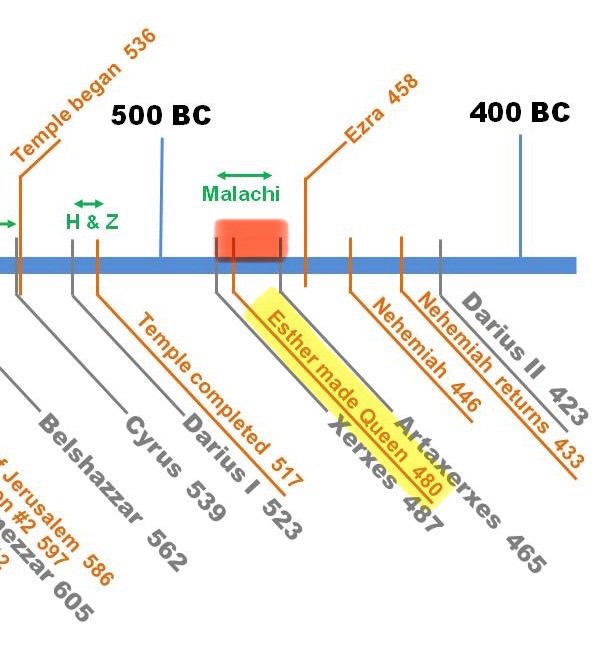
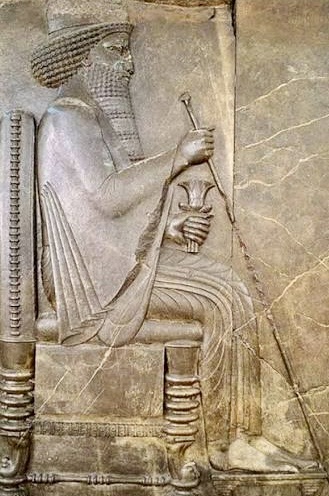
Xerxes I [zerk-sees] was the 5th ruler of the Persian Achaemenid Empire. If the biblical “Ahasueras” was Xerxes I, then his mother was Atossa, a daughter of Cyrus the Great. It was Cyrus who allowed the Jews to return to Judea to rebuild the temple. Xerxes’ father was Darius the Great who had written letters and given orders to supply the materials for the rebuilding of the temple. Darius was not a descendant of Cyrus.
Some scholars identify Ahasueras with Artaxerxes II. There is no historical record outside of the Bible of either Xerxes I or Artaxerxes II (or any other Persian king) having a queen named Vashti or Esther. Some scholars have connected the name Vashti with Stateira, wife of Artaxerxes II. Both men were known to have multiple wives, some unnamed in historic records.
Josephus identified Ahasueras as Artaxeres I, the son of Xerxes I. Unless some ancient tablet is unearthed that explains the names, it will remain unresolved.
If Ahasueras was Xerxes I, then this is him:
“At that time there was a Jewish man in the fortress of Susa whose name was Mordecai son of Jair. He was from the tribe of Benjamin and was a descendant of Kish and Shimei. His family had been among those who, with King Jehoiachin of Judah, had been exiled from Jerusalem to Babylon by King Nebuchadnezzar.”
Esther 2:5-6 NLT
That deportation happened in 597BC. If Ahasueras is Xerxes I, it’s been 90 years since Mordecai’s family left Jerusalem.
There are many ideas about why Vashti didn’t come to the feast. For one thing, Vashti had a separate celebration with the women. The king’s party was for men only. The Jewish Midrash says she refused because the order was for her to appear wearing only her crown. In general, the wives of Persian emperors were meant to be for the delight of the king’s eyes only. It would’ve been considered demeaning to have her gazed upon (even fully clothed) by a bunch of drunken commoners. I say “common” because after a 6-month-long “world’s fair” where the rich and powerful of Persia had been wined and dined, the king hosts a week-long feast for everybody in the city of Susa; even the rabble. It was this party which Vashti refused to attend.
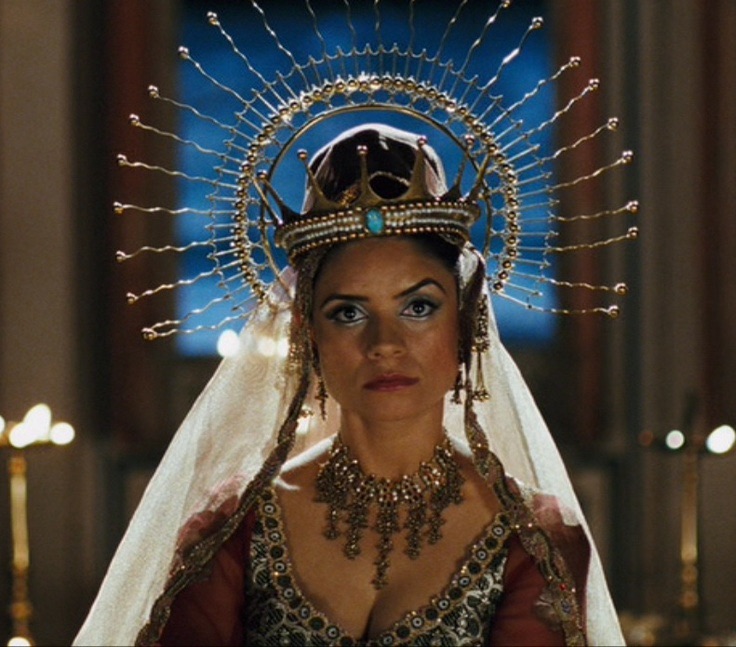
In our day of women’s rights, it feels rather silly to suppose that Vashti’s refusal to be eye-candy for her husband’s drunken party-goers would be enough to upset the entire social order of the empire. I don’t know if they truly believed this or if it was just cultural propaganda.
At any rate, Vashti is banished as a warning to all women to not dare to have an independent thought and men everywhere were encouraged to be as domineering as they liked to keep their women in line.
When beautiful young women are brought in as candidates to be the new queen, it’s like the world’s first reality show. The “contestants” are brought to the palace and placed in the custody of the “host” Hegai. One young woman stood out to Hegai. Esther.
“And the young woman pleased him and won his favor. And he quickly provided her with her cosmetics and her portion of food, and with seven chosen young women from the king’s palace, and advanced her and her young women to the best place in the harem.”
Esther 2:9 ESV
How on earth does one “advance” to “the best place in the harem”? She made it through to the next round of voting or something. Seriously, can you imagine if this story happened today? It would be a reality show with dozens of gorgeous young women, living together in a palace, getting beauty treatments and a “glow up” makeover for an entire year, and then they get one night with “the bachelor.” 🌹
I wouldn’t watch it. I’d frankly rather go to the dentist. But it would probably be wildly popular tv.
And Esther is the winner.
Esther is the only other book besides Ruth that is named for a woman. And Esther is not her real name. Her real name is Myrtle.
🤨 What? No way. That’s a granny name.
Hadassah means Myrtle tree. Esther means “star” and is related to Ishtar, the Mesopotamian goddess of love associated with the planet Venus, “the morning star.”
🤓 Goddess of love? That’s good branding if you’re trying to win The Persian Bachelor.
Interesting thing about Esther and Ruth…
Neither woman has a “regular” family. Ruth is under the guardianship of her mother-in-law, Naomi. Esther is under the guardianship of her cousin, Mordecai.
Esther is a well-connected Jewish maiden who marries a Gentile king and lives in a palace outside the Promised Land.
Ruth is a poor Gentile widow who comes into the Promised Land and marries a Jewish man and becomes the grandmother of the Davidic line of kings.
Both women radically trust the God of Israel at great risk to themselves. Both, through “behind-the-scenes” acts, are instrumental in the saving of the entire nation.
If you haven’t seen the film adaptation Esther called One Night With the King, it’s quite good. And it really emphasizes this text as a plot point:
“Esther had not made known her kindred or her people, as Mordecai had commanded her, for Esther obeyed Mordecai just as when she was brought up by him.”
Esther 2:20 ESV
Another interesting comparison between Ruth and Esther is that Ruth’s ethnicity as a Moabite and Ether’s as a Jew are both problematic in their stories. Ruth cannot hide her ethnicity. It’s all the local gossips can talk about. It makes her vulnerable until Boaz steps in and offers his protection and redeems not only her, but everything that pertained to her family. Esther (Hadassah) is able to hide her ethnicity, but it also makes her vulnerable. She appeals to her husband who also uses his royal power to protect her and her whole family (the Jewish people).
Chapter 2 ends with Mordecai and Esther working together to stop an assassination attempt on the king. This deed is recorded in the court chronicles. And that fact will play an important role soon…
 To The Reader