It’s the NEW TESTAMENT!
After a year and a half we have finally made it to the central point of history!
😐 I feel like there should be some fanfare.
🤓 Allow me… Drumroll please…
🥁
WELCOME TO THE NEW TESTAMENT! 📣
🥳🎉🎊🪩💃🏼🕺🏼🧨🧨🧨🧨🧨🧨🧨🧨🧨

Ya know how I said I had a problem with my keyboard and thought I had “worn it out?” I think I fixed it. I Googled “wireless keyboard repeating keys.” It gave me a list of things to do, the most important of which was “re-pairing” the device. You’ve probably had to do this before. You go into your Bluetooth settings and “Forget this device.” Then you wait a few seconds, turn everything back on, and pair the wireless device again. (I need a wireless keyboard because I do all of this blogging in an app on my tiny cell phone). I re-paired the keyboard and no more random Fffff’s. So yay for that.
And it got me to thinking… We should probably do that with our brains and the New Testament. Temporarily “forget” what we think we know and then re-pair our hearts and minds to the Gospel and New Covenant based, not on some pop preacher’s interpretation or any particular “doctrinal position,” (no matter how beloved, ancient, or revered), but on the text alone, interpreted by the rest of scripture, illuminated by the Holy Spirit, and checked against the agreed-upon teaching of the Church for the past 2000 years.
Eternal Truth will always survive such a test and come through as gold. There is a reason that the fundamental truths of the Gospel have not changed in 2000 years and are shared by all true Christians regardless of denomination. In such a test, the doctrines and interpretations of men will be found to be on shaky ground. And why wouldn’t we want to jettison such things?
It can be scary to genuinely call everything we think we know into question, but the Word of God will not fail. After such a study, the doctrines that are true will be restored to us and we will be more certain of them than ever. The doctrines that lack the textual support we thought they had… well, we can safely set these aside or at least hold them with a light and gracious touch, understanding that there is room for other perspectives held by our brothers in Christ.
If you’ve never read through the OT before, you will find that going into the NT after laying that crucial foundation is going to be an enlightening experience. It’s not a new story popping out of nowhere. It’s the continuation and culmination of the epic story begun in Genesis. And it picks up right where Malachi left off – with the Messenger who comes to prepare the way.
And I think a prayer before we begin would be appropriate. The following is from The Book of Common Prayer, with a little addendum of my own at the end.
🙏
Blessed Lord, who hast caused all holy Scriptures to be written for our learning; Grant that we may in such wise hear them, read, mark, learn, and inwardly digest them, that by patience and comfort of Thy Holy Word, we may embrace, and ever hold fast, the blessed hope of everlasting life, which Thou hast given us in our Savior Jesus Christ.
We trust in Your Holy Spirit to guide us into all truth as Jesus promised, in Whose name we pray. Amen.
The Gospels were not the first books written in the New Testament era. That honor probably belongs to the Epistle of James, followed closely by the Epistles of Paul.
The Gospels, as we know them, were most likely based on earlier written accounts and published in the following order, (though there are always scholars – particularly “critical scholars” who would disagree):
- Mark (and Peter), 50-60AD
- Mathew, 55-65AD
- Luke, 60-61AD
- John, 80-90AD
Technically, none of the Gospels claim an author. John comes closest to hinting at his identity as “the disciple who Jesus loved.” It is very early Church tradition that tells us who wrote the Gospels. And for our chapter today…
Meet Luke…NOT one of the 12 disciples or an Apostle, but a young Greek physician (possibly from the Greek city of Troas) who joined Paul on his 2nd missionary journey.
😲 Wait… Luke wasn’t even Jewish?
Nope. He was Greek. And very well educated.
Both the Gospel of Luke and the book of Acts were written by him for the benefit of a man called Theophilus (which means Friend of God), who may even have supported him financially as he wrote. Scholars speculate that Luke may have done his research and written this Gospel while Paul was imprisoned in Ceasarea. Mary, the Mother of Jesus, was still alive and living with John when Luke wrote. It’s very likely that he interviewed her personally as well as the brothers and sisters of Jesus and the original disciples.
And now… on to the text.
ZACHARIAH & ELIZABETH
Like an echo of Abraham and Sarah in Genesis, the Gospel story opens with an elderly couple who had never been able to have children.
The angel Gabriel appears to Zachariah in the temple as he burns incense on the altar that stood before the veil in the Holy Place. When Gabriel tells Zachariah that Elizabeth will have a son, he quotes from Malachi. Compare:
“And he will turn many of the children of Israel to the Lord their God, and he will go before Him in the spirit and power of Elijah, to turn the hearts of the fathers to the children, and the disobedient to the wisdom of the just, to make ready for the Lord a people prepared.”
Luke 1:16-17 ESV
“Behold, I will send you Elijah the prophet before the great and awesome day of the Lord comes. And he will turn the hearts of fathers to their children and the hearts of children to their fathers, lest I come and strike the land with a decree of utter destruction.”
Malachi 4:5-6 ESV
“Behold, I send my messenger, and he will prepare the way before me. And the Lord whom you seek will suddenly come to his temple; and the messenger of the covenant in whom you delight, behold, he is coming, says the Lord of hosts.”
Malachi 3:1 ESV
Zachariah, no doubt, understood the reference. Gabriel is telling him that their son will be THAT Messenger. God’s Messenger. Those are 2 stupendous claims.
- An elderly barren couple will have a child
- This child will be the one prophesied by Malachi to prepare the people for the coming of the LORD.
No wonder Zachariah – righteous man though he was – found it hard to believe. Contrast his response with that of Mary. Gabriel tells her 2 impossible things too.
- A virgin will conceive a child
- This child will be the One prophesied by ALL of the prophets and even going all the way back to God’s promise in Eden that the “Seed of the Woman” would crush the Serpent’s head.
Mary only says 2 things. She first asks a clarifying question, “How shall these things be?” In other words: “How will I conceive?” She doesn’t know this story like we do. For all she knew, maybe she was supposed to marry Joseph and conceive naturally. Or, does she need to go somewhere or do something special? Once Gabriel explains, her beautiful response of faith is,
“Behold, I am the servant of the Lord; let it be to me according to your word.”
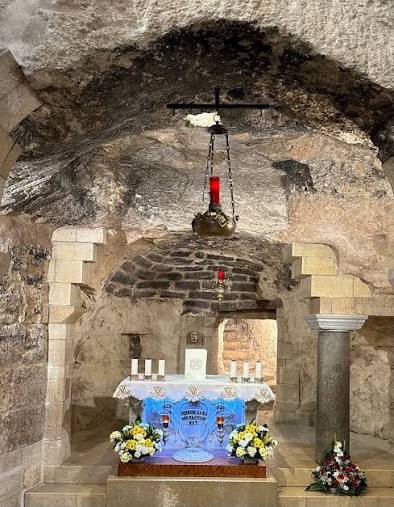
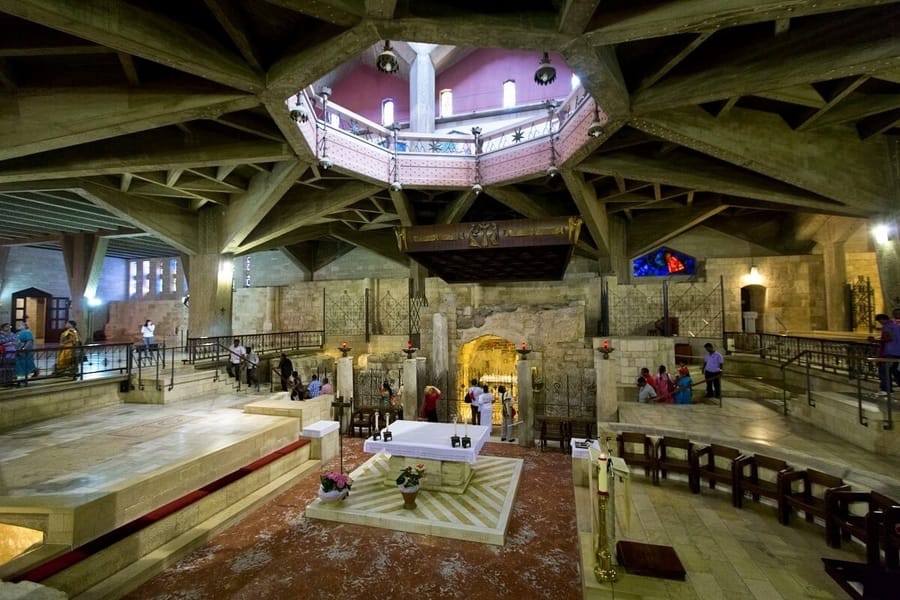
Protestants I think, in our reaction to the veneration of Mary by Catholics, fail to give her the honor she truly deserves. This young maiden displayed a more robust faith than that of an educated and seasoned priest – Zachariah. There is not the slightest hint in the text that she so much as hesitated.
Now, if you are a young woman who has been told by an angel that you will supernaturally conceive a divine child, where else would you go but to your relative who is carrying a divinely ordained child, miraculously conceived after an angelic visit? This is an utterly unique situation. Mary needed Elizabeth and the LORD chose them as a pair and orchestrated every detail.
MARY VISITS ELIZABETH
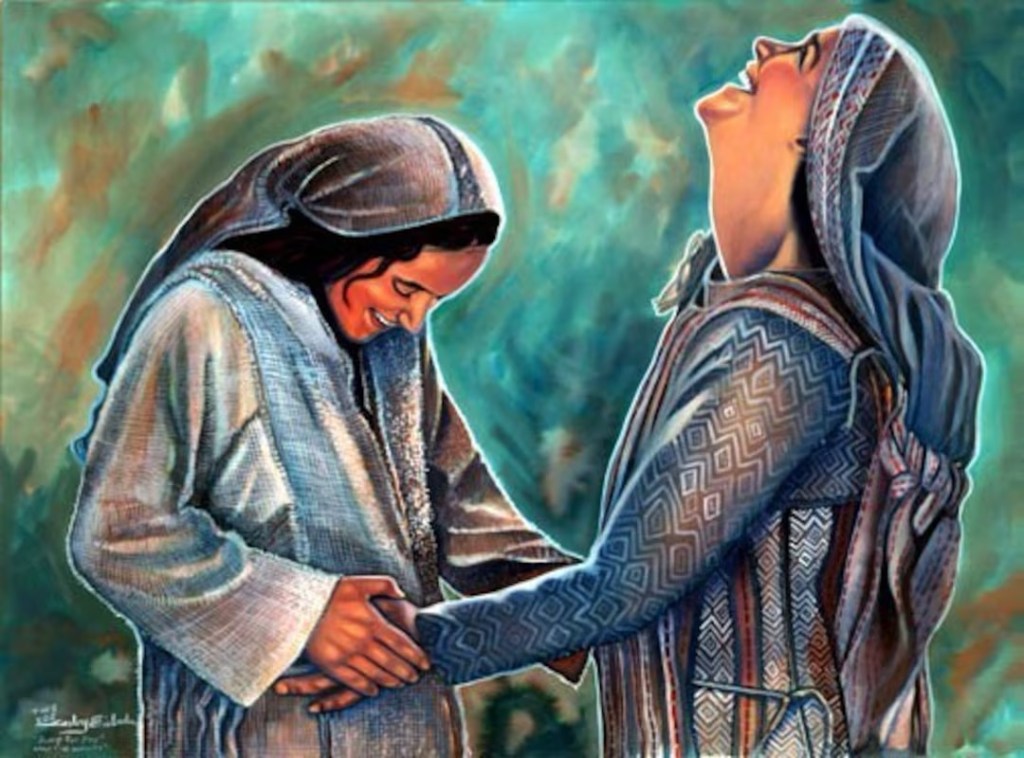
Not only would the child of Zachariah and Elizabeth be “filled with the Holy Spirit” in utero, but Elizabeth herself was “filled with the Holy Spirit;” probably at the same moment as baby John when he leapt in her womb upon hearing the greeting of Mary.
Then Elizabeth quite honestly goes full-on prophetess mode for a second. Because, before Peter confesses “Thou art the Christ,” before Martha tells Jesus, “I believe that you are the Christ, the Son of God,” before Nathanael said, “Rabbi, you are the Son of God! You are the King of Israel!” And even before the Angel announced to the shepherds that the baby in the manger was “Christ the Lord,” here is Elizabeth acknowledging that the secret speck embedded in Mary’s womb is “my Lord.”
“And why is this granted to me that the mother of my Lord should come to me?”
Luke 1:43 ESV
THE MAGNIFICAT
This inspired declaration of Mary’s was one of the earliest songs of the Church. It was being sung in the first century before the death of John who took care of Mary. Perhaps Mary herself set it to music. It was probably done as a “responsive chant” and seems to have been used mostly in evening prayer gatherings. It has been given dozens of musical settings over the centuries and has never ceased to be used in worship. Here is a particularly lovely arrangement – probably from the late Medieval period or thereafter by the sounds of the more complex harmonies.
The words of Mary’s declaration are like the “cliff notes” version of another woman’s prayer; a woman who prayed and prayed for a child and was finally granted her request: Hannah, the mother of Samuel. Her profession of praise is found in 1 Sam. 2:1-10. Comparing her words side-by-side with Mary’s, you realize that Mary is paraphrasing Hannah. I’ll share a bulleted summary, but these passages are worthy of detailed comparison. It would make for a fantastic lesson for a women’s fellowship; especially around Christmastime.
Both begin by celebrating in the Salvation of the LORD.
- Hannah – “My heart rejoices in the Lord. I rejoice in Thy salvation.”
- Mary – My soul magnifies the Lord. My spirit rejoices in God my Savior.”
Both next have a section where the proud and mighty are put down and the weak and humble are lifted up.
- Hannah – “Talk no more so exceeding proudly…” “The bows of the mighty are broken and they that stumbled are girded with strength.”
- Mary – “He has scattered the proud in the imagination of their hearts. He has put down the mighty from their seats and exalted them of low degree.”
Next, in Hannah’s prayer she speaks at length about how the full and rich have become hungry while the hungry poor are made full. Mary sums up Hannah’s whole segment in a single statement.
- Hannah – “They that were full have hired out themselves for bread, and they that were hungry ceased (to be hungry).”
- Mary – “He hath filled the hungry with good things, and the rich He hath sent empty away.”
Then, both women make statements about God helping His people.
- Hannah – “He will keep the feet of His saints and the wicked shall be silent and in darkness…”
- Mary – “He has helped His servant Israel in remembrance of His mercy…”
Finally, both narratives end with the speaker going home. The Samuel text names Hannah’s husband Elkanah. The implication is that Hannah went home with him.
- “Then Elkanah went home to Ramah. And the boy was ministering to the Lord in the presence of Eli the priest.”
1 Samuel 2:11 ESV - “And Mary remained with her about three months and returned to her home.” Luke 1:56 ESV
There is NO WAY this is coincidental. I think the Holy Spirit is drawing parallels between these two women for a reason. Both women needed God’s intervention to conceive. Both women bore sons which were utterly given to the LORD and who – from young ages – were aware of their purpose and calling.
Samuel was a prophet but because he was given to the LORD, he lived at the Tabernacle and wore the attire of a priest even though he was not a descendant of Aaron or the tribe of Levi.
Jesus was the ultimate prophet and he was (and is) also a priest though not a descendant of Aaron or the tribe of Levi.
Jesus’ 3 ministries, prophet, priest, and king, is a rare combination outside of Himself. So, many OT pictures of Him feature 2 of the 3: priest and king (Melchizaek, David, Joshua son of Josedech). Samuel gives us a picture of a different combination.
BIRTH OF JOHN THE BAPTIST
The Hebrew name is Yochanan, meaning, God is gracious. Zachariah confirms the baby name choice on a clay tablet and suddenly, he can speak again. And speak he does. He is “filled with the Holy Spirit” – making Zachariah, Elizabeth and John the first entire family to be filled with the Holy Spirit – and he prophesies over little John.
And in this prophecy, we again have a reference back to Malachi 3:1 about preparing the way for the Lord, but there is a reference to another part of Malachi:
“And you, child, will be called the prophet of the Most High; for you will go before the Lord to prepare his ways, to give knowledge of salvation to his people in the forgiveness of their sins, because of the tender mercy of our God, whereby the sunrise shall visit us from on high to give light to those who sit in darkness and in the shadow of death, to guide our feet into the way of peace.”
Luke 1:76-79 ESV
Malachi also spoke of a rising sun.
“But for you who fear my name, the sun of righteousness shall rise with healing in its wings. You shall go out leaping like calves from the stall.”
Malachi 4:2 ESV
When Zachariah mentions those who “sit in darkness in the shadow of death” having light shine upon them, he is quoting Isaiah 9:2. In the context of verse 1, the people about to see the great light are those who live in the land of Zebulun and Naphtali of Galilee. That’s where Nazareth is located.
 To The Reader