Y’all… I have hemmed and hawed and procrastinated and prayed. My Bible lies open to John 1, the margins packed with notes, but it’s an intimidating, fearful thing. It feels a lot like that time I did a ropes course and had to jump off a 3-story platform on a zip line. It took me a while to get up the nerve.
I feel neither qualified nor worthy to handle this glorious book. No doubt there are people out there there who would heartily agree that I have no business writing anything even remotely instructive about the Gospel of John. And perhaps they would be right. I cannot interpret Greek. I know the Greek alphabet (sort of), I know a handful of Greek words (oikos does NOT mean “yogurt”), and I’m aware of the verb tenses enough to look them up and apply them but I make no claims to being an actual New Testament scholar. I do feel capable of explaining most NT theology but would only consider myself a “junior” theologian.
But I have committed myself to blog my way through the Bible and so I must do something.
Put the cookies on the bottom shelf.
That’s what I will try to do.
Scholars often keep the cookies way up on a high shelf out of reach. I’m not yet able to make scholarly cookies, but I can reach them. And if you don’t tell the grown-ups, I’ll climb up there and get them down.
Thus begins the great cookie-heist of John’s Gospel – and indeed the New Testament.
😯 Ooo… what kind of cookies? Warm chocolate chip cookies? 🍪 That’s my favorite.
🤓 Peanut butter? I like warm peanut butter cookies – with their little criss-cross tops sprinkled with sugar.
☝️🤓 WITH a cold glass of milk.
I was speaking of figurative cookies.
🤨 Never heard of that flavor.
🤓 Are they Girl Scout Cookies?
No.

Ho boy….
Moving right along…
The first 18 verses of the Gospel of John are among the most sublime words to ever grace the ear of man.
Of the 4 Gospels, people who do evangelism almost always use the Gospel of John.
I once read that John’s Gospel was like the ocean. The shallows near the shore are safe enough for little children to splash and play in. But the full extent of its depths have yet to be explored.
John’s Gospel was the last to be written. And it is quite different from the other three which are called the “Synoptic Gospels” because of how similar they are. Roughly 90% of the content in John is only in John. There are no parables. There are 12 “I Am” statements. Over HALF of the book is spent on Jesus’ final days and hours.
My Thompson Chain Study Bible has this helpful outline for John:
- The Prologue (1:1-18)
- The Manifestation of Christ’s Divinity to the world (1:19-12:50), 6 witnesses:
- John the Baptist
- The Holy Spirit
- The Disciples
- Jesus’ Mighty Works
- The Father
- The Scriptures
- The Private Revelation and Instruction to the Disciples (ch 13-17)
- His Humiliation and Triumph Over Death (ch 18-20)
- The Epilogue (ch 21)
Because of this structure, John is best read on its own from beginning to end without splitting it up. But since this read-though is chronological, we will introduce it here, dip into it lightly as we make our way though the story of Jesus, and lean upon it heavily as we get to the final week of Jesus’ ministry on earth.
So…. without further ado…
(Heaven help me) 🙏
“In the beginning was the Word, and the Word was with God and the Word was God.”
This is the Logos. Greek philosophers had long discussed the idea of “the Logos,” “the Word” before John wrote this opening verse. I knew the idea predated the birth of Christ but I wasn’t sure how far back it went, so I asked Google.
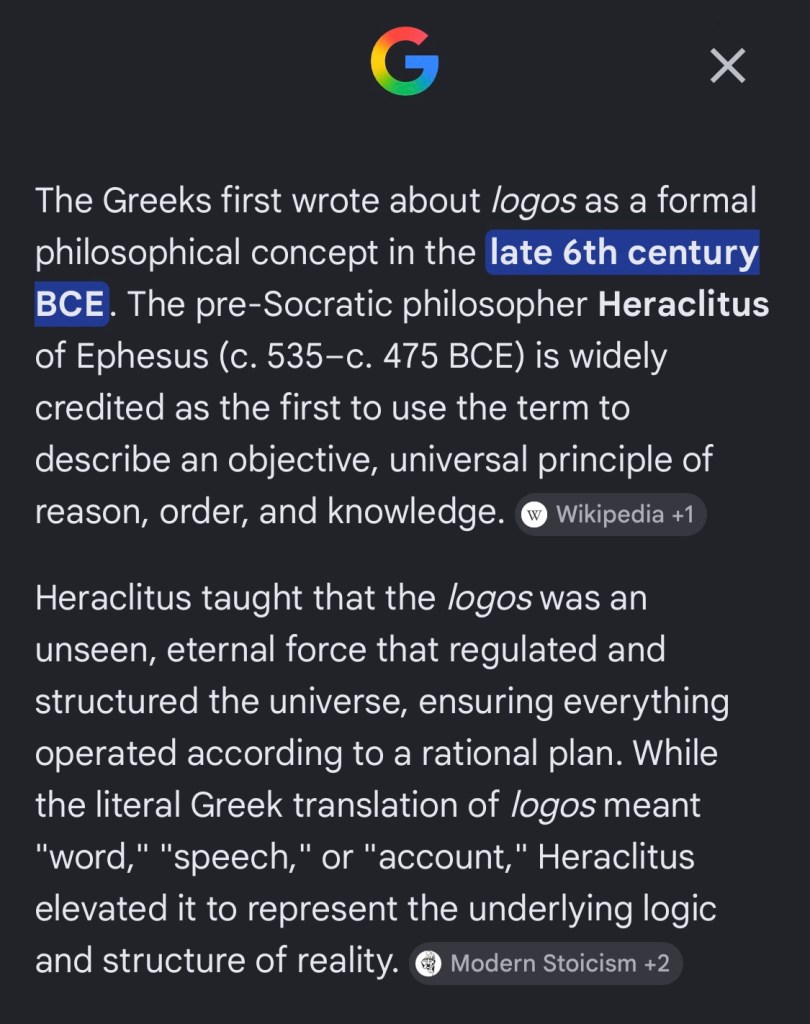
“…an unseen, eternal force that regulated and structured the universe, ensuring everything operated according to a rational plan.”
I think if Heraclitus had been able to discuss these ideas with Jesus, Jesus might’ve said to him as He said to the scribe in Mark 12:34, “You are not far from the Kingdom of God.”
Paul described Jesus to a primarily Greek congregation in terms of this logos idea:
“He is the image of the invisible God, the firstborn of all creation. For by him all things were created, in heaven and on earth, visible and invisible, whether thrones or dominions or rulers or authorities—all things were created through him and for him. And he is before all things, and in him all things hold together.”
Colossians 1:15-17 ESV
Christ is indeed the “underlying logic and structure of reality.” It is this universality that makes John’s opening portrait of Christ so accessible and relevant to every human no matter what race or culture or era. We all live within the “structure of reality.” We all live within the physical universe and its overlapping spirit-realm. And John says that this reality in which we all live and move and have our being was made by the Jesus of his Gospel.
John opens with “In the beginning…” as the Genesis of the New Testament. That is very much on purpose. He is intentionally showing that, while the human body of Jesus came into existence in the womb of Mary, the immaterial Soul and Spirit inhabiting that body did not begin at that point. He was in the beginning with God from Genesis 1:1. He is Himself God. Eternal. The Agent of creation.
When God SAYS, “Let there be light,” that is the Word in action. That is the Logos; the speech, the vocalized Mind of God.
And this Word – the very mind and thoughts of God – “became flesh and dwelled among us.”
If Jesus of Nazareth was just another man- wise and good and even powerful – but only a human man, then He would have a sinful nature as all men do and could not bring Salvation. John knows this. And it’s why he takes pains to make it crystal clear that Jesus is no ordinary man. He is the God-man. The Divine Human. John writes what he does for a specific purpose. And he even tells us what that is:
“but these are written so that you may believe that Jesus is the Christ, the Son of God, and that by believing you may have life in his name.”
John 20:31 ESV
This Gospel is designed to present the incontrovertible evidence that Jesus is none other than the promised Divine Messiah, the Son of the Most High. Because…
“… to all who did receive him, who believed in his name, he gave the right to become children of God, who were born, not of blood nor of the will of the flesh nor of the will of man, but of God.”
John 1:12-13 ESV
Remember how we encountered “The Sons of God” in Genesis and Job and Psalms?
“Sons of God” is a technical term. It is used in the Bible ONLY of direct creations of God. The angelic host was made directly by God. He didn’t make an Adam-angel and an Eve-angel and have them make a bunch of chubby cherub babies. 👼 No. Angels aren’t born. Each one is a direct creation and so they are called “the Sons of God.”
Adam is called “the Son of God” in Luke 3:38 because Adam didn’t come from a mother. He was made directly by God.
Jesus is the only begotten Son of God; the only one uniquely born of woman.
And those who believe on the name of the Lord Jesus and are born of the Spirit are given “the right to become children of God.”
Direct creations of God. New creations.
No longer quite entirely human, but born of the Holy Spirit into God’s own Divine family. You are literally a brother or sister to Gabriel and Michael and the rest of the heavenly host – and, far more importantly, to Christ Himself, (Jn. 20:17, Heb. 2:10-18, Rom. 8:14-17). We have the same Father.
🪑 Here’s a chair in case that thought makes you a little lightheaded. This is John. We’re at high altitudes here and one must frequently stop and rest and take in the staggering view.
☁️☁️☁️☁️☁️☁️☁️☁️☁️☁️☁️☁️☁️☁️☁️☁️
“No one has ever seen God; God the only Son, who is at the Father’s side, he has made him known.”
John 1:18 ESV
This is a crucial statement that helps us interpret all those divine-encounters we read about in the OT. It’s why Moses was not permitted to look on the face of God. No one in the OT ever saw the unveiled fullness of God. It would’ve killed them. Not Abraham or Isaiah or Daniel or anyone else. They saw “the Angel of the LORD” (the embodied form of God that wouldn’t kill them with glory). Or, they saw “the glory of the LORD” – some manifestation of the LORD’s presence (like Ezekiel). These were absolutely REAL encounters and they interacted with God, but, as it were, through a buffer.
The Son… He HAS seen the face of God the Father. Unveiled. In full force and glory. He’s the only One Who has. And He came, not just to tell us about Him. But to REVEAL Him.
Part of me wants to stop here and pick back up with the rest of John once we get to the Baptism of Jesus in the other Gospels.
There is SO much in John 1! The description of Jesus’ baptism, the first disciples, Simon’s name changed to Cephas/Peter, Nathanael’s confession of faith, and Jesus’ response to that confession where He identifies Himself as “Jacob’s Ladder” – the stairway to Heaven.
I don’t really want to get ahead into Jesus’ ministry before we’ve read about His birth, but since most of you have already read all of John 1, I’ll just touch on one thing.
“Jesus turned and saw them following and said to them, “What are you seeking?” And they said to him, “Rabbi” (which means Teacher), “where are you staying?” He said to them, “Come and you will see.” So they came and saw where he was staying, and they stayed with him that day, for it was about the tenth hour.”
John 1:38-39 ESV
I think Jesus looks at us following – reading through the Bible – and would ask us the same question, “What are you seeking?”
I encourage you to sit a minute with that question and try to answer it.
Whatever you or I are looking for, Jesus’ answer is “Come and you will see.”

