Merry Christmas! (In July) 🎄🎁
Luke, the Greek Physician, wrote his gospel from Greek background and for a Greek audience.
John was Jewish but begins his gospel with the Greek Logos, packed with universal application to all peoples, and writes so that “whosoever” (Jew or Gentile) will believe.
Matthew (also called Levi, possibly a Levite) wrote his gospel clearly aimed at a Jewish audience. He quotes more of the OT than the other gospels and heavily uses the terms “Christ” (Messiah) and “Kingdom of God” more than the others. He is writing to show Jesus as the Jewish Messiah. So he begins with Jesus’ genealogy tracing his descent from Abraham, through the kingly line of Judah and David. You probably recognized the names of the many kings of Judah in Jesus’ family tree. This lineage ends at:
“Jacob fathered Joseph the husband of Mary, by whom Jesus was born, who is called the Messiah.”
Matthew 1:16 NASB2020
This is very carefully worded to make it clear that Joseph was NOT the physical father of Jesus. But as the husband of Mary, Joseph was the legal “father” of Jesus and through him comes the legal inheritance of the throne of David.
This is probably why only Matthew records Joseph’s dilemma on finding Mary “with child.” His Jewish audience would want an explanation on how a righteous Jewish man married a woman found to be pregnant with a child that was not his.
LUKE 2
Luke tells us some details about the political situation at the time. Caesar Augustus is Emperor of Rome. Judea is much as we left it in Malachi – an insignificant district ruled over by an enormous empire.
Some of us could probably quote much of Luke chapter 2 like Linus in the classic, Merry Christmas Charlie Brown.

After centuries of waiting and prophetic promises, the time has finally come. And instead of announcing it to the priests at the temple or kings on their thrones, the Angel of the LORD announces it to a group of shepherds in the fields of Bethlehem.
Think back over the OT… what else happened in a field in Bethlehem?
Do you remember the story of Ruth and Boaz? They met in a field of Bethlehem.

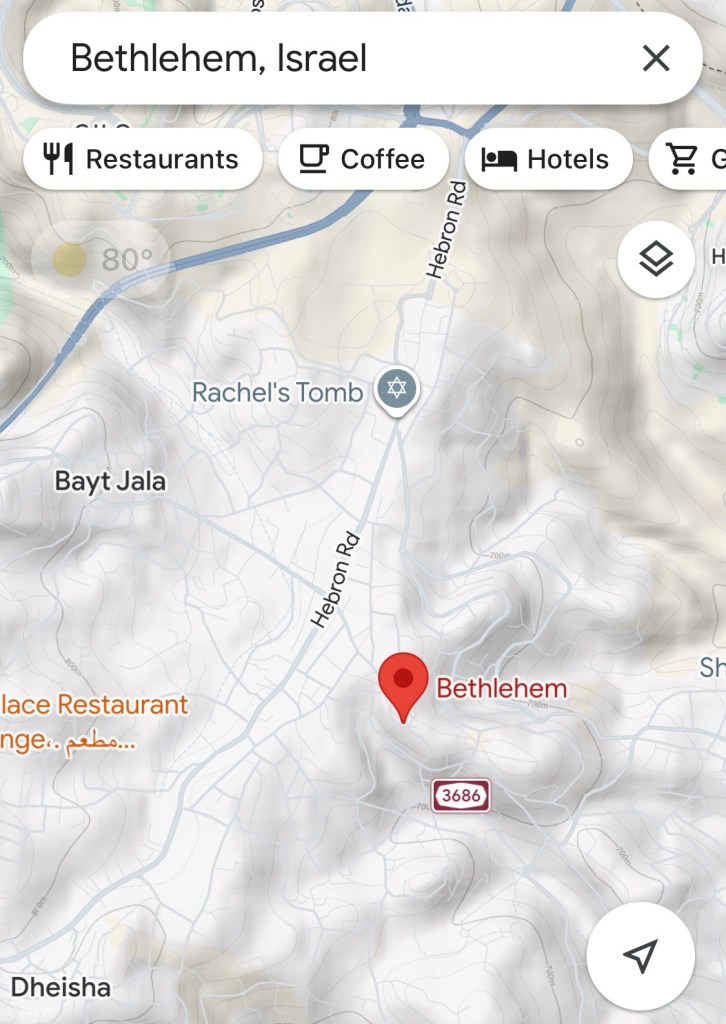
The “fields” of Bethlehem were not vast flat plains. They were rolling hills with a few level-ish spots.
There were a lot of people in Bethlehem for the census. Perhaps even several very small babies. How were the shepherds to know which was the Messiah? Here’s how:
“And this will be a sign for you: you will find a baby wrapped in cloths and lying in a manger.”
Luke 2:12 NASB2020
How many babies in Bethlehem do you think are lying in an animal feed trough?
Just one.
I imagine the shepherds going from house to house asking to look in the animal enclosure. Then finally finding one with a baby in the feed box.
Let’s talk about where Jesus was born.
The place where Mary and Joseph found shelter would not have been a detached “barn” like this:

There are 3 main ideas about what type of shelter Jesus was born in.
- The stable of a public inn
- A cave (often used to shelter animals)
- A stable of a house
We’re all familiar with the fact that there was “no room in the inn.” Note that the text never mentions an inn-keeper turning Mary and Joseph away. That is pure fabrication.
The Greek word in Luke 2 translated as “inn” is…

It’s the exact same word for the place where Jesus ate the Passover (the Last Supper) with His disciples. Jesus tells Peter and John to ask about the kataluma where he could eat the Passover. And they are shown an “upper room,” Luke 22:11-12.
Kataluma is translated “guest-chamber.” It’s a second-floor (upper) room.
In the story of “the Good Samaritan” (Luke 10:30-37) the injured man is placed in an “inn”; a place where lodging is paid for by the Samaritan. That word is:
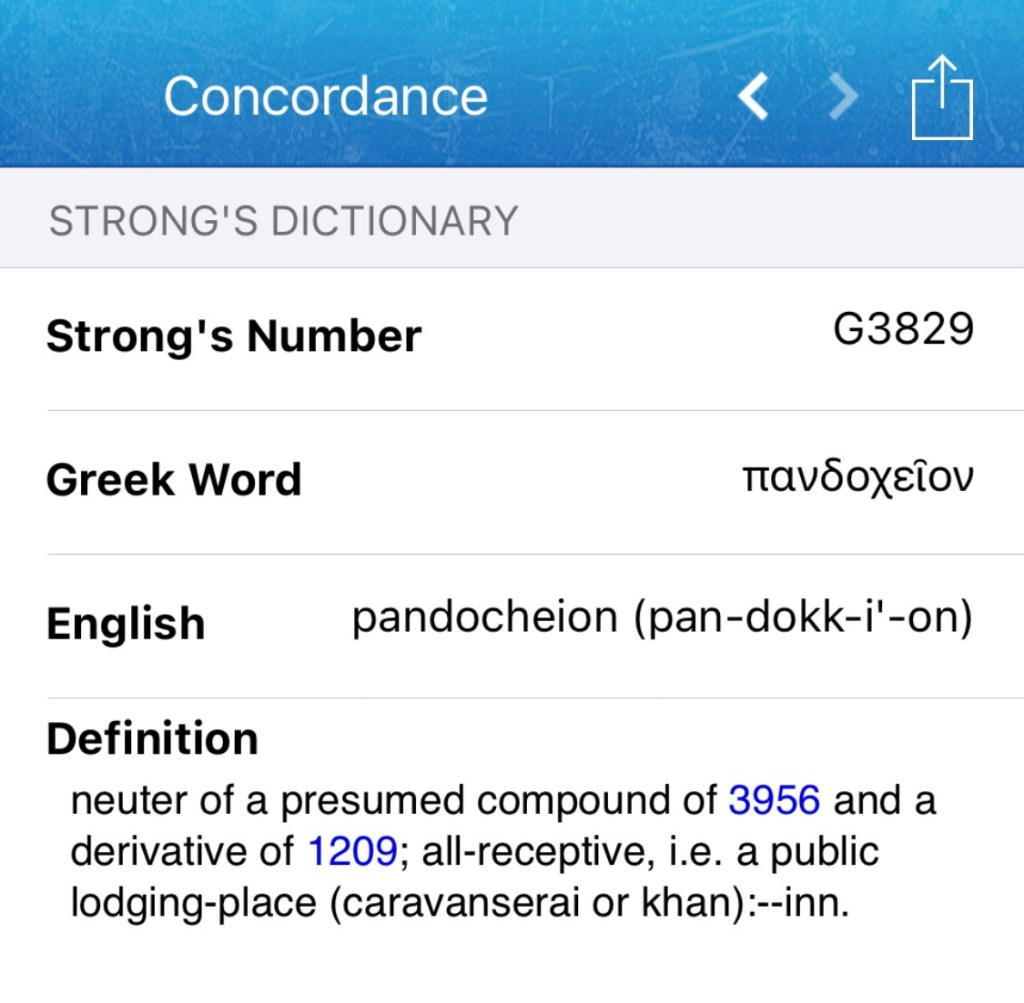
The place where there was “no room” was NOT a pandocheion, a public lodging place. Luke knows and uses that word elsewhere. He says there was no room in the kataluma; the guest-chamber, the “upper room.”
Many first-century Judean homes were built like this:
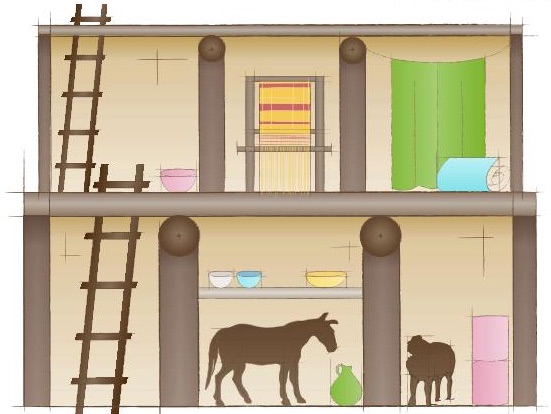
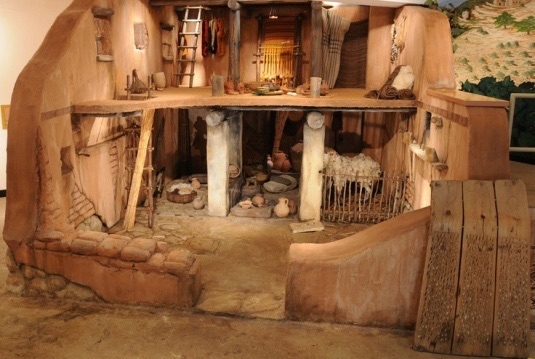

People still live in this kind of an arrangement. We call them garage-apartments. There’s a garage below (a place to park your horse-power and store stuff) and a living space above.
It’s possible, or even likely, that Jospeh sought accommodation among relatives.
If the “upper room” or “guest chamber” was already full, but the lower storage area was available, it would make sense to stay there. Mary is about to go into labor.
And, a woman cannot have a baby without making everything she touches “unclean” (according to the Law) from all of the bodily “issues” involved in childbirth. Going to a separate space keeps the living area above ritually clean.
Another thing is that the shepherds were living out in the fields with the sheep overnight. In cold and wet winter weather, they’d be more likely to bring the sheep into folds (often caves) at night and lead them out during the day. It’s quite likely that Jesus was born in a milder season. There are many speculations about what day Jesus was actually born. I think the date suggested by Dr. Michael Heiser is extremely intriguing. Click HERE to watch a 10-minute video that shows how Revelation 12 just might be describing an 80-minute window of time for the birth of the King, on September 11, 3BC.
🤔 So we should celebrate Christmas in the garage in September?
I suppose you could if you want. Open the garage door. Invite the pets. Fire up the BBQ grill. And if you DO decide to celebrate Christmas on September 11, I’d like to nominate the song September by Earth, Wind, & Fire as an honorary Christmas Carol. 🪩 💃🏼🕺🏼
🤨 How is that song Christmasy?
Well, “love is here to stay,” there are bells ringing and instead of Fa-la-la-la-la it’s Ba-du-da, Ba-du-da, Ba-du-da, Ba-du-da…
🤓 She has a point.
It doesn’t bother me in the least to celebrate the birth of Christ on December 25, even if I know that it’s probably not the correct date. If the whole world is going to stop and acknowledge the Savior, I’m here for it.
SIMEON & ANNA
I love that Luke includes these details about Simeon & Anna. Both of them function with prophetic insight. And they demonstrate that there were people in Israel who were actively expecting the Messiah to come.

Simeon’s prayer “Lord, now let thy servant depart in peace…” became (along with Mary’s Magnificat), one of the earliest songs of the Church. In Latin it is called the Nunc Dimittis. It’s been 2000 years and people are still singing the words of Luke 2:29-32. Here is a modern arrangement that evokes the ancient chants. It’s sung by one of the most exceptional vocal ensembles on earth right now: Voces8. (For the best experience, use headphones or earbuds.)
BOY JESUS IN THE TEMPLE
This is the only scriptural account of Jesus’ life between His birth and adulthood. He was 12 and had likely just experienced “Bar Mitzvah” where he gets to go into the part of the temple reserved for Jewish adult men, called “The Court of Israel.”

This Passover was likely the first time Jesus had ever watched the lambs be killed.
And then after Unleavened Bread and Firstfruits (which would be the day of His future resurrection), Jesus “tarried in Jerusalem” (Lk. 24:49) for about 5 more days before Joseph and Mary found Him.
When they do, Jesus asks a question.
“And he said to them, “Why were you looking for me? Did you not know that I must be in my Father’s house?””
Luke 2:49 ESV
These are the earliest recorded words of Jesus. In John’s gospel, the first words from the mouth of Jesus are: What seek ye? (John 1:38)
Allow me to do a bit of mashup between Luke 2 and John 1.
What are you looking for?
“Where dwellest Thou?”
Why are you looking? I must be in my Father’s house.
WHAT are you looking for?
WHY are you looking?
Two very important questions which we should explore in our own hearts very deeply.
What am I looking for?
An easy life? Security? Significance? Respect? Belonging? What are we REALLY looking for? We will only find what our hearts are looking for in Jesus.
Maybe we just assumed that Jesus was around somewhere among the group. (Especially if you were “raised in Church”) My friends and the people in my small group seem to have seen Him recently. I’m sure He’s around somewhere.
Why are we searching everywhere (except the right place) in a frantic worry when we can’t seem to find Him? He isn’t lost. He hasn’t abandoned us- even if it has been days since we’ve seen Him. He expects us to know where He is. “Don’t you know?” He asks.
He is in His Father’s house.
“Come and see.”

